
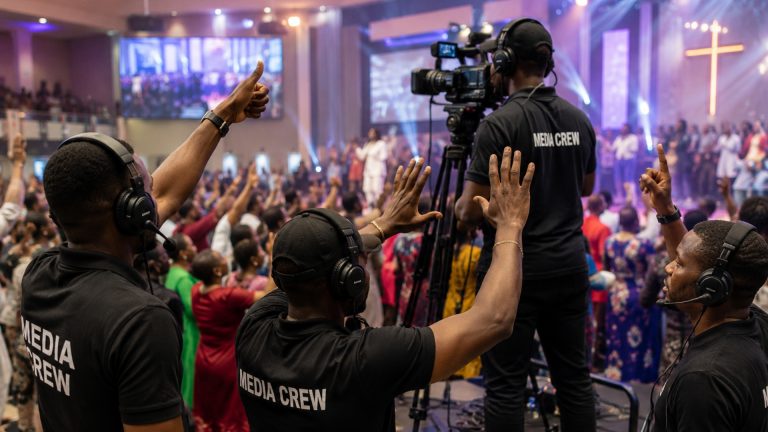
Renting a comms system doesn’t make your crew a professional crew, the same way buying a gym membership doesn’t give you abs.
We’ve supplied communications headsets to hundreds of productions across Lagos, and we can tell within five minutes of listening to a channel whether a crew knows what they’re doing. The gear is identical. The talking is not.
The good news: comms etiquette isn’t complicated at all. It’s a small set of habits that broadcast crews have refined over decades, and you can teach them to your team in one briefing. Here’s the playbook.
Rule 1: Name first, then message
On an open channel, everyone hears everything. If you just start talking, nobody knows who you’re addressing, and four people half-react at the same time – wahala everywhere. The fix is the oldest rule in broadcast:
Say who you’re calling, then who you are, then the message. “Lights, this is Femi – standby for entrance look.” The lighting operator’s brain switches on at the first word, and everyone else relaxes.
For small crews who know each other’s voices, “Lights, standby entrance” is enough. The principle stands: address before message.
Rule 2: “Standby” and “Go” are sacred
Every cue has two parts. Standby means: it’s coming, get ready, hands on faders. Go means: now.
“Standby music fade… and… go.”
This two-step rhythm is why professional shows feel tight. The operator isn’t reacting to a surprise instruction – they were poised three seconds before it came. A crew that masters just this one habit eliminates most of the late cues that make camera operators miss their moments.
One warning: once you say “standby,” the next thing the operator hears from you should be “go” or “stand down.” Don’t say “standby” and then wander into another conversation.
Rule 3: Acknowledge everything
When you receive an instruction, say so. “Copy.” “Got it.” One word.
Silence is poison on comms. If the show caller says “Camera 2, push in on the cake” and hears nothing, she doesn’t know if camera 2 heard, disagreed, or has a dead battery. Now she’s repeating herself, the channel is clogged, and trust in the system erodes. We’ve seen entire set days lost to exactly this spiral.
“Copy” costs half a second. Pay it every time.
Rule 4: Keep the channel clean
The channel belongs to the show, not to gist. No commentary on the MC’s outfit, no lunch debates, no humming along to the band. It’s not about being boring – it’s that the one moment someone needs the channel urgently is always the moment someone else is mid-story.
The professional standard: if your message doesn’t help someone do their job in the next few minutes, it doesn’t go on comms.
Related: learn your system’s mute button. Coughing, eating, side conversations with someone next to you – mic off first. An open mic next to a speaker stack can also feed noise to the whole crew, which is its own troubleshooting headache.
Rule 5: Speak like a newsreader, not a conductor
Counter-intuitive but true: the more urgent things get, the calmer your voice should be. Shouting on comms triggers panic, and panicked crews make mistakes. The legendary show callers – the ones running live concert broadcasts with fourteen people on channel – sound almost bored while calling the busiest sequences. Flat, clear, even pace.
Also: short sentences. “Caterers, hold service till after speeches” beats a forty-word explanation of why.
Rule 6: Report problems, don’t broadcast panic
Something will go wrong – a mic dies, a generator hiccups, the celebrant is late. The professional format is problem, location, action: “FOH, podium mic is dead, switching to handheld, need thirty seconds.”
What you don’t do is narrate distress (“ah, this thing has spoiled o, who touched it?”). One states a situation and a plan; the other spreads anxiety to ten ears at once.
Rule 7: Brief the crew before doors open
Five minutes, before the event, everyone on headsets:
Confirm everyone can hear and be heard (do a quick roll call). Agree on names – who is “Lights,” who is “Floor.” Remind the team of the big cues of the day: entrance, speeches, cake, surprise act. State who the caller is – one voice runs the show, everyone else supports.
That last point matters most. Comms work when there’s a clear hierarchy: one show caller directing, everyone else responding. Two people giving orders on one channel is worse than no comms at all.
A note for first-time crews
If your team has never used comms before – common with church volunteer teams (more here) and first-time event crews – don’t worry. When we deliver a system, our technician runs this exact briefing with your team and stays through the event if you want. By the second hour, everyone talks like they’ve done it for years.
Renting comms for an upcoming production? We’ll set it up, brief your crew, and make you sound like professionals. Message 527 Sounds on WhatsApp for a quote.