
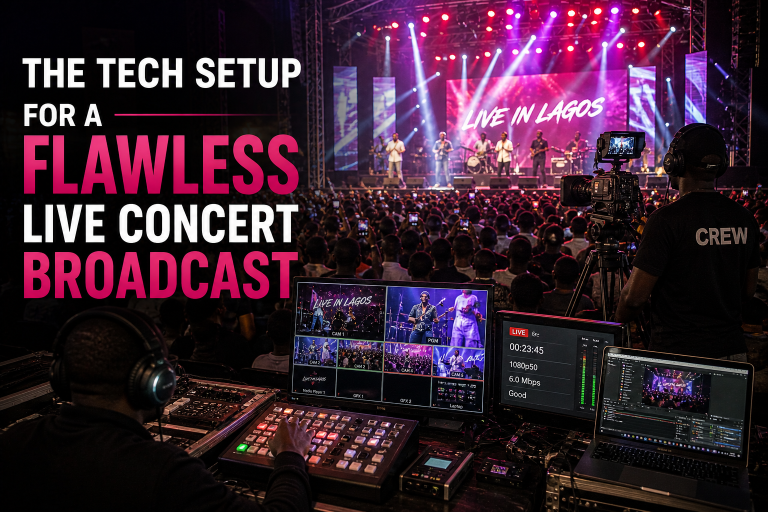
When thousands of fans stream a live concert from Eko Hotel or Tafawa Balewa Square, they see a seamless show. They see dynamic camera angles, hear perfect audio mixes, and witness flawless lighting transitions. What they don’t see is the high-stress, intensely coordinated dance happening behind the scenes.
A flawless broadcast involves the communication infrastructure that ties the entire crew together. Here is a look at the essential live concert broadcast tech setup that makes the magic happen.
The Complexity of Live Concert Production
A live concert broadcast involves dozens of moving parts. The technical director sits in a control room (or an OB van) calling shots. Camera operators are stationed across the arena. The audio engineer is mixing the live band, while the lighting designer is executing cues.
If the director cannot instantly communicate with the camera operator to get the wide shot before the chorus drops, the moment is lost forever on the live stream.
Essential Audio Routing and Network Infrastructure
Before a single note is played, a massive network of cables and wireless systems must be deployed. Modern broadcasts rely heavily on Dante networks or similar digital audio-over-Ethernet solutions. This allows hundreds of audio channels to be routed between the stage, the front-of-house (FOH) mixing console, and the broadcast truck without signal degradation. It’s the backbone of the entire operation.
The Role of Wireless Intercom Systems for Stage Managers
While cables handle the music, wireless intercoms handle the people. Stage managers are the lifeblood of a live show. They must constantly move around the stage, coordinating talent and ensuring props are ready. They cannot be tethered by cables.
A premium wireless intercom system allows the stage manager to stay in constant, full-duplex communication with the director. It is the only way to effectively execute complex cues.
Coordinating Cues Between Audio, Lighting, and Video
The beauty of professional comms systems is “partyline” routing. The director can speak to everyone at once, or isolate a channel just for the camera crew, ensuring the audio and lighting teams aren’t distracted by irrelevant chatter.
Preventing Interference in Crowded Lagos Venues
Lagos is a city saturated with radio frequencies (RF). Between local TV stations, thousands of smartphones in the crowd, and security radios, the airwaves are congested. Using cheap walkie-talkies will almost guarantee audio dropouts on your set.
Professional broadcast tech setups use frequency hopping and digital encryption to guarantee the director’s voice always cuts through the noise.
Rent Broadcast-Grade Comms from 527 Sounds
You cannot run a premium broadcast on amateur communication gear. If you are producing a major live event in Lagos, you need the reliability of industry-standard intercoms. At 527 Sounds, we provide robust, interference-free comms setups tailored for live broadcasts. Contact us today to secure your broadcast comms package.
FAQs
While cameras and audio mixers are crucial, the communication system (intercoms) is arguably the most vital. Without it, the director cannot coordinate the different departments to create a cohesive show.
Camera operators wear headsets to receive real-time directions from the technical director, who tells them when to pan, zoom, or prepare for an upcoming shot before cutting to their camera on the live feed.
527 Sounds provides industry-standard, multi-channel intercom systems specifically designed for the demanding environments of live concert broadcasts and TV productions in Lagos.
By using digital, frequency-hopping wireless intercoms instead of analog walkie-talkies. Digital systems automatically switch to clear frequencies if they detect interference.