
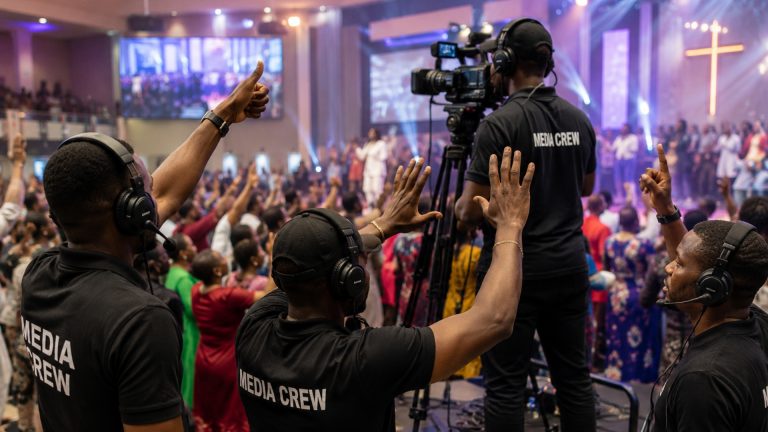
There’s a silent comedy that plays out in churches across Lagos every Sunday. The media team lead, at the back of the auditorium, is trying to tell the camera operator near the altar to widen his shot.
He waves. The camera operator doesn’t see him. He waves bigger.
A first-timer in row 12 waves back, confused. Finally, someone sends a WhatsApp message, which the camera operator reads ninety seconds later – long after the moment that needed the wide shot has passed.
Meanwhile, the livestream watched by members in Abuja, London, and Atlanta has been stuck on an awkward shot of the choir’s elbows the whole time.
We’ve seen this happen so many times. If this is your church, you’re not alone, and the fix is simpler than you think.
Why this matters more than it used to
Ten years ago, church production was a microphone and a mixing desk.
Today, a mid-sized Lagos church runs a multi-camera livestream, projection, stage lighting, and song-lyric graphics – a genuine live broadcast, every single Sunday, operated mostly by volunteers.
Live broadcast has one iron rule: the team must communicate in real time. Every TV station on earth runs on communications headsets for this reason. Churches doing broadcast-level production with hand signals are playing football with their bootlaces tied together o.
What changes when a church gets comms
With a comms system, your service director, sound engineer, livestream director, camera operators, and stage hand all share one private channel. Here’s what Sunday sounds like:
“Cameras, worship is closing after this chorus – Camera 1, standby on Pastor’s entrance.”
“Media, next song is ‘Way Maker’, get lyrics ready.”
“Sound, Pastor is using the handheld today, not the lapel.”
“Ushers’ lead, we’re extending worship – push announcements by ten minutes.”
Every transition that used to be a scramble becomes a sentence. The camera stops missing key moments. The lyrics appear on the first line of the song, not the third. The livestream looks intentional.
And here’s the under-rated part: comms are quiet. No more production whispers near the front row, no more volunteers speed-walking down the aisle mid-sermon.
The congregation experiences pure, undistracted worship, and the production disappears into the background, which is exactly the philosophy behind invisible event audio.
“But our team are volunteers”
That’s an argument for comms, not against.
A professional crew can sometimes survive bad communication on experience and instinct. Volunteers can’t – they’re serving with sincere hearts and three weeks of training.
Comms gives them a director’s voice in their ear, telling them exactly what’s needed and when. New camera operators become useful in one Sunday instead of three months. Mistakes are caught and corrected in real time and privately, rather than being visible to the whole congregation.
The etiquette is learnable in a single briefing – we wrote the whole playbook in how pro crews talk on headsets, and it applies to church teams word for word.
What a church comms setup looks like
For a typical Lagos church running a livestream, the channel includes: the service director or production lead (the “caller”), the front-of-house sound engineer, the livestream/video director, each camera operator (usually two or three), and a stage hand for transitions. That’s six or seven headsets – the full role-by-role logic is in our headset count guide.
A hybrid setup keeps costs sensible: wired beltpacks at the fixed positions (sound desk, video station, camera platforms) and wireless only for the people who move, like the stage hand and service director. The wired vs wireless breakdown explains the trade-offs.
Rent first, buy later (or never)
Here’s our honest advice to church boards: don’t buy a comms system yet. Start by renting for your big Sundays – Easter, anniversary, conventions, crusades.
You’ll learn how many units you actually use, whether wireless range covers your auditorium, and whether the team takes to it.
If comms becomes essential weekly infrastructure, then a purchase conversation makes sense, and you’ll buy exactly the right system instead of guessing. The same rent-before-you-build logic applies to most church AV, it’s the reason we tell podcasters to rent gear before building a studio.
Renting also pairs naturally with the minimalist approach many fellowships are taking with sound generally – see our minimalist guide to in-house worship sound.
This Sunday could sound different
Imagine your next big service: worship flows into the word without a gap, every camera cut lands on the right moment, lyrics arrive on time, and your volunteers actually enjoy serving because they always know what’s happening next.
That’s not a bigger budget. That’s seven headsets and one briefing.
Talk to us about your church’s setup – auditorium size, team size, what Sundays look like – and we’ll recommend a comms package with clear pricing, plus a technician to train your volunteers on the first run. Message 527 Sounds on WhatsApp.