
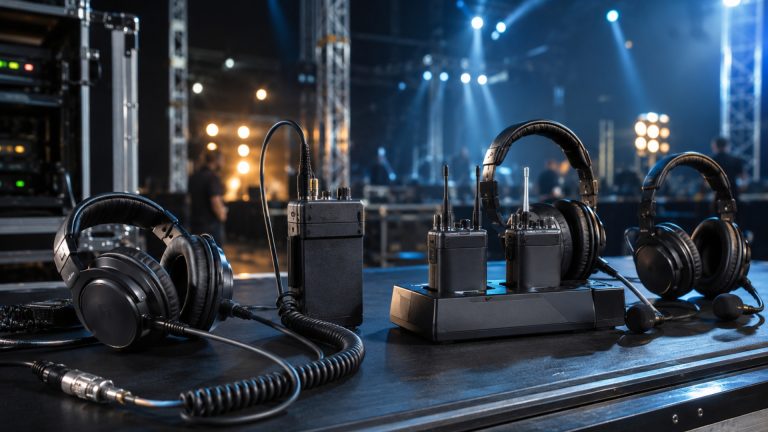
When people picture production comms, they picture wireless – a floor manager gliding through a crowd, talking into a sleek headset, free as air.
So it surprises them when they visit a professional broadcast truck or a big Lagos concert and find half the crew happily plugged into cables.
There’s a reason the pros still use wired intercom in 2026, and there’s a reason wireless keeps winning ground anyway.
We’ve set up comms for hundreds of productions in Lagos, and the same conversation comes up every time. If you’re deciding which to rent for your event, here’s the honest comparison – including the answer most rental companies won’t lead with, which is that you probably want both.
How each one works
Wired intercom connects each beltpack to a base station with a cable. Power and audio travel down the same line, which means no batteries to manage and a connection that physically cannot drop. It’s the system television studios have trusted for fifty years.
Wireless intercom replaces the cable with a dedicated radio link. Each beltpack has a battery and talks to a base station or antenna. Modern systems are full-duplex – everyone talks and hears simultaneously, like a phone conference, not like walkie-talkies where you wait your turn. (If you’re still weighing walkies against proper intercom, start here.)
The case for wired
It cannot drop out. No interference, no range limits, no battery anxiety. For a camera operator on a fixed platform during a live broadcast, this certainty is gold. A wireless glitch during a livestream is exactly the kind of failure we dissected in how to prevent audio dropouts on set.
It’s cheaper. Wired beltpacks rent for noticeably less than wireless. If four of your seven crew positions never move, putting them on cable cuts your comms bill significantly – we showed the math in our rental price guide.
It runs forever. Twelve-hour Lagos wedding? Owambe that starts at 2pm and somehow ends at 2am? Wired packs don’t care. No battery swaps, ever.
The case against: cables. Someone has to run them neatly and tape them down, they limit movement to the length of the line, and in a venue where the layout changes during the event, they’re a headache.
The case for wireless
Total freedom of movement. The floor manager chasing the bridal party, the talent wrangler moving between green room and stage, the producer who needs to be everywhere – these roles simply cannot work on cable.
Faster setup. No cable runs to plan, tape, and strike. For events with tight venue access – and Lagos venues love giving you 90 minutes to set up – wireless saves precious time.
Cleaner look. High-end events increasingly demand that production be invisible. No cables across the floor fits the same philosophy as our piece on invisible event audio.
The case against: batteries need managing on long events (solved with spares and a charging station), range has limits in sprawling or concrete-heavy venues, and the units cost more to rent. Wireless also demands a bit more technical care – frequency coordination matters when other wireless gear (mics, in-ears) shares the venue. This is one of the quiet reasons comms setups fail when handled by inexperienced crews.
The Lagos factor
Two local realities shape this decision more than any spec sheet.
First, venues. Lagos event centres range from glass-walled halls in Oniru to converted warehouses in Ilupeju. Concrete and metal eat wireless range. A system that covers 300 metres in open air may struggle across a venue with thick pillars and a mezzanine. An experienced rental partner does a quick venue assessment, or asks the right questions, before recommending a system.
Second, the RF environment. Big Lagos events are crowded with wireless: microphones, in-ear monitors, livestream encoders, hundreds of phones. Professional wireless intercom on dedicated, coordinated frequencies handles this fine; cheap uncoordinated units do not. If a quote seems too good to be true, ask what band the system runs on. We’ve seen this wahala firsthand.
What the pros actually do: hybrid
Walk into any serious production – a concert broadcast like the ones in our live concert tech breakdown, a multi-camera church service, a big corporate launch – and you’ll find the same pattern:
Wired for fixed positions: front-of-house desk, video switcher, camera platforms, dimmer city. Wireless for movers: floor manager, stage manager, producer, talent handler.
This hybrid approach gives every role the connection style it needs and keeps the budget sane. When we build a comms package, this is almost always what we propose. Figuring out which of your roles are “fixed” and which are “movers” is half the work – our guide to how many headsets your event needs walks through exactly that.
Quick decision guide
Choose all wired if your whole crew sits at fixed positions and budget is tight. Choose all wireless if you have a small crew (3–5) that all move, like an event planning team running a wedding. Choose hybrid for everything else – which, in our experience, is about 70% of events in Lagos.
And if you’re new to comms entirely, start with our complete guide to communications headsets for Lagos events.
Let’s spec it for you
Send us your venue, crew list, and event date, and we’ll recommend the exact mix – how many wired, how many wireless, how many channels – with a clear price. No overselling; gear that sits unused doesn’t come back as a repeat customer.
Message 527 Sounds on WhatsApp – we usually reply within the hour.