
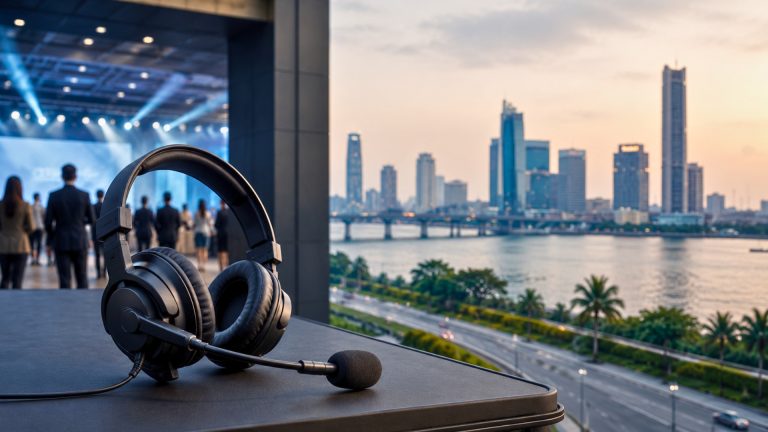
Communication headsets are very important. From our recent experiences, many event planners totally skip this part, very important part of an event.
You’ve probably seen this scenario before. You attend an event where the lights dim at exactly the right second. The MC walks on stage just as the music fades. The caterers appear the moment the speeches end.
None of that is luck o. Somewhere behind the scenes, the production team is talking to each other on communications headsets, and that quiet conversation is the reason everything looks effortless.
If you’re planning an event, shooting a film, or running a church production in Lagos and you’re still coordinating with phone calls and frantic waving, this guide is for you.
What exactly are communications headsets?
A communications headset system (often just called “comms” or an intercom system) lets your entire crew talk to each other hands-free, in real time, on a private channel.
Each person wears a headset connected to a beltpack, and everyone on the channel hears everyone else instantly, no phone call network wahala, no “hello, can you hear me?”, no network issues.
This is a very important event workflow, because whether you’re in a basement hall in Victoria Island or an open field in Epe, your crew needs stays connected.
Who actually needs comms?
More people than you’d think:
- Event planners and coordinators. A wedding with ten vendors is a logistics operation. Comms let the planner cue the DJ, the lighting tech, and the kitchen without leaving her post. We’ve written about how top Lagos planners stay calm all day using exactly this setup.
- Film and TV crews. When a director needs camera two to reframe right now, a hand signal across a noisy set doesn’t cut it. Missed cues are almost always communication failures, and we broke this down in why camera crews miss cues.
- Live broadcast teams. Concerts, award shows, and church livestreams all depend on a director talking to camera operators in real time. See our guide to the best live broadcast headsets in Nigeria.
- Churches. Multi-camera livestreams run on comms. More on that in why Lagos churches are ditching hand signals.
- Corporate event teams. Product launches and conferences with slides, videos, and panel transitions need a stage manager who can whisper “go” to the right person at the right time.
The main types of comms systems
Wired intercom
The classic setup: beltpacks connected by cable to a base station.
Wired systems are extremely reliable because they don’t depend on batteries that die mid-show, or have wireless interference, and they’re usually cheaper to rent. The trade-off is mobility. They’re perfect for fixed positions like a front-of-house mixing desk, a camera platform, or a broadcast control room.
Wireless intercom
Beltpacks that connect over a dedicated wireless link, giving your crew full freedom to move. A floor manager chasing down a missing groomsman, an usher lead working the room, a drone operator outside the hall can use a wireless system.
Modern systems like Hollyland and Clear-Com wireless give you several hundred metres of range with crystal-clear, full-duplex audio (everyone can talk and listen at the same time, like a normal conversation).
Not sure which suits your event? We compared both in detail in wired vs wireless intercoms in Lagos.
What about walkie-talkies?
Walkie-talkies still have their place (security teams and parking marshals love them). But for production crews, the push-to-talk, one-person-at-a-time format is painfully slow.
We’ve compared them head-to-head in walkie-talkies vs intercom headsets for corporate events and Clear-Com vs traditional radios if you want the full breakdown.
How to choose the right system for your event
Ask yourself three questions:
1. How many people need to talk? A four-person crew has different needs from a fifteen-person production team. Our guide on how many headsets your event needs walks through this role by role.
2. Do they need to move? Fixed positions can go wired and save money. Roaming roles need wireless.
3. Do you need separate channels? Bigger productions often run two or more channels (one for the video team, one for stage management), so that the camera director’s instructions don’t clutter the planner’s channel.
If you can answer those three questions, you’re 90% of the way to the right setup. And if you can’t, that’s fine too, because that’s literally what we’re here for.
Renting comms in Lagos: how it works
Buying a professional comms system makes sense if you run productions every week. For everyone else, renting is the smarter move, because you get the latest, well-maintained equipment with fresh batteries and a technician who sets it all up before your call time.
A typical rental from 527 Sounds includes the headsets and beltpacks, the base station or antenna setup, charging and spare batteries for all-day events, delivery anywhere in Lagos, and on-site setup and testing before your event starts. Costs vary with the number of units and whether you go wired or wireless, we have published real figures in our comms headset rental price guide.
The bottom line
Bad communication is expensive. Missed cues, awkward silences, vendors doing their own thing, and your guests may not know why an event felt disorganized, but they always feel it. We’ve seen it cost real money on film sets too (here’s the true cost of bad communication on set).
Good comms, on the other hand, are nearly invisible. Your event just… works.
Planning something in Lagos? Tell us about your event and we’ll recommend the right comms setup, no jargon, no overselling. Message us on WhatsApp and let’s talk it through.