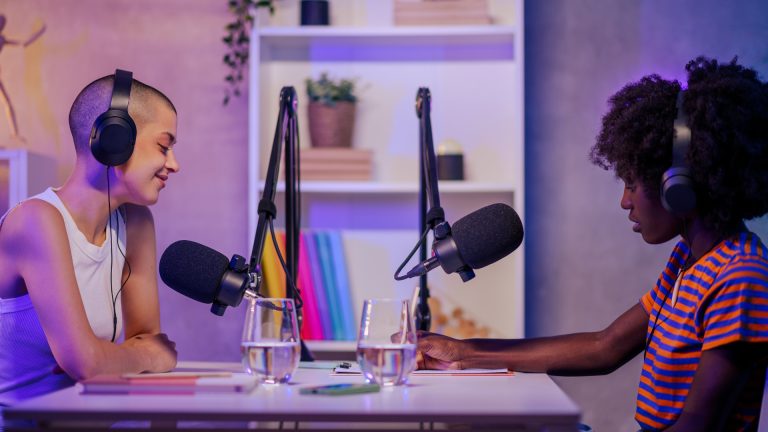
Open Instagram and it looks like everyone in Lagos has a podcast now. Open YouTube and you’ll see why people hesitate to start one: the big shows have studios that look like spaceship cockpits, and it’s easy to assume you need ₦10 million worth of equipment before you can press record.
You don’t o. But you do need the right pieces – and skipping the wrong one is the difference between a show that sounds professional and one that sounds like a voice note.
From our experience setting up podcast sessions across Lagos, we’ve seen people spend wrong in both directions. This checklist will help you get it right.
This is the complete checklist, in priority order, with honest notes on what you can skip when starting out.
1. Microphones – the non-negotiable
Your microphone matters more than everything else on this list combined. Listeners forgive average video; they do not forgive bad audio.
Dynamic microphones (Shure SM7B, Rode PodMic, Shure MV7) are the podcast standard for a reason that’s especially relevant in Lagos: they reject room noise. The generator next door, the danfo horns, the echo of an untreated room – a dynamic mic ignores most of it. Condenser mics sound beautiful in treated studios and merciless everywhere else.
One mic per person, always. Two people sharing a mic is the fastest way to look and sound amateur. For shows with three or four guests, mic choice gets more nuanced – we wrote a full guide to the best microphones for multiple podcast guests.
Skip: USB “streamer” mics if you ever plan to have guests. They’re fine solo, but you can’t cleanly run four of them into one computer.
2. Audio interface or mixer – the brain
Professional XLR microphones don’t plug into laptops; they plug into an interface or mixer, which converts the signal and lets you set levels. Which one you need depends on your format: a simple two-input interface covers a solo or two-person show, while multi-guest video podcasts are far easier on a podcast-specific console like the Rodecaster Pro, which gives every guest their own channel and headphone feed. The full decision logic is in audio interface or mixer? A Lagos podcaster’s guide.
3. Headphones – the cheapest mistake-preventer
Closed-back headphones for every person on mic. Not AirPods – closed-back, wired headphones (the Audio-Technica M20x class is fine). They let you hear problems while you can still fix them: a mic too far away, a hum from a bad cable, a guest who drifts off-axis. Recording without monitoring is how people discover, after the guest has gone home, that the whole episode is unusable. It’s mistake #1 in our list of podcast gear mistakes Lagos creators keep making.
You’ll also want a small headphone amp or splitter once you have more than two people, so everyone gets a feed.
4. Stands, booms, and cables – the unglamorous backbone
Every mic needs a proper stand or boom arm – table vibrations travel up cheap stands and into your recording every time someone taps the table or shifts a cup. Budget for quality XLR cables too, plus one spare. In our rental experience, cables cause more session failures than any other component, precisely because nobody thinks about them.
5. The video layer – cameras and lights
If you’re doing video (and in Lagos right now, video is where the audience growth is), you’ll add cameras – one wide shot plus one per speaker is the standard grammar – and lighting, which matters more than the cameras themselves. A modestly priced camera under good, soft lighting beats an expensive camera under your sitting-room bulb, every time.
This layer is its own topic: see our video podcast setup guide for Lagos for cameras, lights, and framing.
6. The room – the gear nobody sees
An untreated Lagos room – tiled floor, bare walls, glass windows – adds echo that no editing can fully remove. Before you buy a single acoustic panel, try the free fixes: record in a room with curtains, rugs, and a sofa; face the mic away from windows; get close to the mic. Our guide to making any Lagos room sound like a studio covers the cheap-but-effective options.
7. Power and backup – the Lagos special
NEPA is part of your production team whether you like it or not. A small inverter or charged power station that can run your interface, lights, and laptop for two hours means a power cut becomes a non-event instead of a lost session. If you record remote guests, data backup matters too – here’s how to record remote guests properly.
The honest question: should you buy any of this yet?
Here’s the part most gear lists won’t tell you: if you’re starting out, you probably shouldn’t buy this equipment yet. Test your format first – record five episodes with rented professional gear and find out whether your show has legs before committing millions of naira. We made the full argument in why you should rent podcast gear before building a studio, and real rental figures are in our podcast equipment rental price guide.
A rented kit arrives as a complete, working set – mics, console, headphones, stands, cables, lights – already matched to each other, with someone to set it up. Episode one sounds like episode fifty.
Ready to record? Tell us your format (solo, interview, panel, video or audio-only) and we’ll put together the exact kit – to rent for your first episodes or as a shopping list if you’d rather buy. Message 527 Sounds on WhatsApp.