
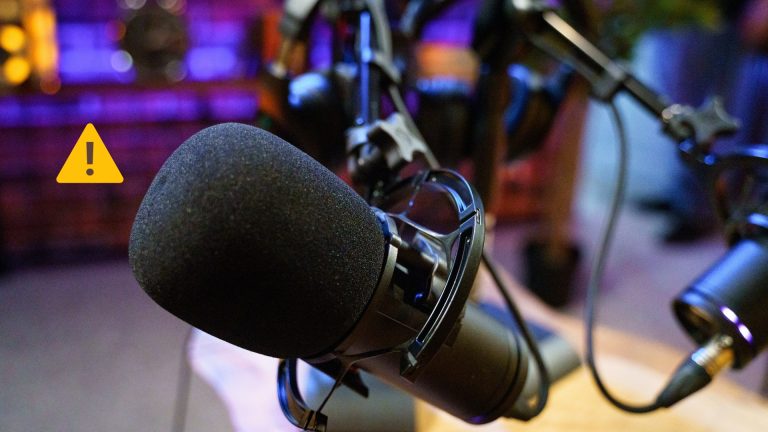
We rent podcast equipment across Lagos, which means we’ve seen the inside of more recording sessions than almost anyone.
We’ve watched flawless first episodes and disasters, and here’s the pattern: disasters are rarely caused by cheap gear. They’re caused by the same seven mistakes, made by smart people, over and over.
Read this before your next session. It’s free, and it’ll save you real money and real heartbreak.
1. Recording without headphones
The number one session-killer, by a distance.
If no one is monitoring through closed-back headphones while recording, nobody knows what’s actually being captured. The mic that got bumped now points at the ceiling. The hum from a dodgy cable. The guest whose voice clips into distortion with every laugh. You discover all of it after the guest has gone home, when nothing can be fixed.
Headphones for every person on mic, levels checked before the first question, someone listening throughout. This single habit prevents more ruined episodes than any equipment upgrade on earth. We say this to every creator we work with o.
2. Using one microphone for two people
It feels economical. It sounds like a hostage video.
A mic placed “between” two people is positioned correctly for neither – both sound distant and roomy, and the room echo (Lagos rooms have plenty) fills the gap. Worse, your editor can’t balance two voices that live on one track.
One mic per mouth. Always. If budget is the issue, renting four broadcast mics for a session costs a fraction of buying two (see real numbers), and for picking the right mics for panel formats, our multi-guest microphone guide has you covered.
3. Buying a condenser mic for an untreated room
The classic Computer Village mistake. Condenser mics are marketed as “studio quality,” and they are – in a studio. In a tiled Lagos sitting room, that beautiful sensitivity faithfully captures every echo, every fan, every generator within a hundred metres.
Podcasters in imperfect rooms need dynamic mics, which hear what’s close and reject what’s far. It’s why the SM7B/PodMic class dominates podcasting worldwide. Full reasoning in the equipment checklist.
4. Sitting an arm’s length from the microphone
You bought the right mic and it still sounds thin and distant? You’re too far away.
Broadcast mics are designed to be worked close, about a hand-span from your mouth. Close means your voice dominates and the room disappears; far means the room joins the show.
This transforms recordings instantly. (It’s also half of all “acoustic treatment,” as we explain in making any Lagos room sound like a studio.)
The related sin: drifting. New hosts lean back when they relax and turn away when they laugh. Boom arms help – they keep the mic in your eyeline, following your face like it’s part of the conversation.
5. Setting gain by vibes
Gain: how much the interface amplifies your mic; has a correct setting; and “turn it up until it seems loud” isn’t it. Too high and every laugh distorts permanently (clipping cannot be repaired in editing; that information is simply gone). Too low and boosting it later drags hiss up with it.
The two-minute fix: have each speaker talk at their real energy (including laughing) and set gain so the loudest moments peak comfortably below maximum (around -12dB on the meters).
If your setup involves multiple guests with different voice levels, this is exactly where a proper console earns its keep over a basic interface – see audio interface or mixer?
6. No backup, no spares, no plan B
One SD card, one cable per mic, recording only to a laptop that’s at 30% battery – this is a session begging to fail. And in Lagos, NEPA will eventually accept the invitation.
The pro minimum: a spare XLR cable, spare storage, devices charged or plugged into protected power, and where possible a redundant recording (consoles that record to SD while also feeding the laptop give you this for free). On-location sessions need even more discipline – our mobile recording guide covers the travelling version.
7. Buying everything before recording anything
The most expensive mistake on the list, and the most common.
The excitement phase goes: idea → name → logo → ₦3 million of equipment → four episodes → silence. Podfade is real, and gear bought in week one becomes very discounted Jiji listings by month six.
Meanwhile, the gear you guessed you’d need is rarely the gear your actual format turns out to want, panel shows, interview shows, and video shows all have different shopping lists.
The smarter sequence: rent a complete professional kit for your first several episodes, learn what your show actually is, then buy – if you still want to.
Your first episodes sound broadcast-quality (better than beginner-grade gear would sound), and your eventual purchases are informed instead of hopeful. We made the full argument in rent your podcast gear before building a studio.
The pattern behind all seven
Notice that almost none of these are about owning better equipment. They’re about technique and process – monitoring, mic discipline, gain, backups, sequencing your spending. That’s good news: it means the gap between amateur and professional sound is mostly knowledge, and you just acquired it.
Want the shortcut? Our rental kits arrive with a technician who sets the gain, positions the mics, hands everyone headphones, and quietly prevents every mistake on this list. Message 527 Sounds on WhatsApp – tell us your format and we’ll sort the rest.